Saturday, 15 August 2015

SHAME


Here is the text I have been forbidden to read at today’s commemoration. No doubt the mayor of Alonnisos has his reasons for not wanting the story told publicly in a language most foreign visitors understand; it would be interesting to know what they are.


 The murderers arrived in our island in the early hours of August the 15th 1944, some landing at Mikro Mourtia, others at Patitiri. On their way up to the village they deceived whomever they met by telling them they were ELLAS fighters, and fished for information about the national resistance movement. They wore no German uniforms or insignia.

On arrival in the village, with the help of local collaborators who knew they were coming,  they gathered all the men over 18 years of age into this little space: Maniacally ringing the church bell they brought out everybody and announced that any man who didn’t appear would have his house burnt down and he himself be executed once found. It was now obvious to all that these so-called ELLAS fighters were the country’s enemies: murderous invaders and their Greek collaborators.

Next they read out the names from a list prepared by local collaborators of all those who belonged, or were suspected of belonging, to the resistance. Any who, hoping to escape, failed to answer to their names were pointed out to the murderers by local traitors. Once the deathly catalogue was completed, they stood the victims against the parapet and tied their hands, each man to the next, with the ropes from the pack-saddle of a nearby donkey.

During the few terrible moments of the execution, a bullet happened to sever the rope where it joined the last man to the series. Badly injured as he was he jumped over the parapet in a desperate attempt to escape. But the murderers had stationed a machine-gunner on the opposite hill, known as ‘Paliomylos’, (Where the restaurant ‘Astrofengia’ stands now) and the escapee was riddled with bullets. Nevertheless he managed to get away and took refuge in the nearby stream-bed known as Lakka. At once the women of the village, risking their lives, ran to give him — what else? Water. The seriously injured in battle always ask for water. After drinking the water he gave up the struggle for life. He was Athanasios  Xydeas, our beloved fellow islander, known as Thanasakis.

As soon as their dreadful crime was over, the German murderers and their collaborators set out for Patitiri where a boat was waiting for their escape. But before leaving local traitors led them to the house of Panayiotis Tsoukanas, near the church of Ayios Nikolaos. Panayiotis had been lucky enough to be out of the village when the roll was called. They burnt his house to the ground. Continuing towards Patitiri they reached, down by the Alonia, the house of Georgios Morisis, who had been among those executed. This house too they burnt to the ground.


The Victims:

Michael Kyriazis.

Nikolaos Alexiou.

Nikolaos Florous.

Agallos Anagnostou.

Agallos Agallou

Georgios Morisis.

Athanasios Xydeas.

Georgios Smyrnaios.

A tenth victim was Georgios Syrianos, a left-wing local politician from Volos, who was in Alonnisos at the time.

Two more people should be mentioned:

Yorgos Alexiou, who was fatally injured by the collaborating police officer Kourlos, and died on board a ship bound for Smyrna, where he was buried.

Nikos Athanasiou, a left-wing thinker, who was betrayed by Greek collaborators with the Nazis, taken to Peristera and tortured in an unheard-of manner: a metal band was fixed round his head and tightened with screws until the pain and brain-injury killed him.


From the commemorative speech given by
Georgios Athanasiou, August the 15th 2012.

Editing and translation ©Simon Darragh 2012.


The picture below shows Dr Yorgos laying a wreath at the 2012 ceremony.


Friday, 14 August 2015

The Circular Logic of the Blinkered Idiot


The 15th of August is, in the Greek Orthodox calendar, the feast of the Assumption of the Virgin Mary; one of the most important days, even for the not-very-religious, in Greek culture. Among the other events here in this island there is a ceremony in the upper square of the old village, dedicated to the memory of the victims there of the massacre on that same day in 1944. Our local doctor reads a speech, telling the story of what happened.

Understandably, the whole ceremony, including the doctor’s speech, is in Greek, so a while ago I suggested to the doctor that it might be a good idea if at least a resumé of his speech, translated into English, were read — this is of course the very height of the tourist season, and many foreigners have asked me to explain what happened. Doctor Yorgos thought mine a good idea, so I made an accurate translation of his speech, précised it, and was all set to read it after his own speech.

However, on the morning of the 14th, I was told by the waitress in the place where I go for my morning coffee, that the mayor has forbidden my reading. We telephoned the doctor to ask for confirmation of this, and an explanation. He said that indeed the mayor had forbidden my reading of a speech in English, that he didn’t know why, but would ring back. He duly did so: the mayor says there’s no point in there being anything in English at the ceremony, because no foreigners ever come to it anyway.
 

Wednesday, 12 August 2015

It's the heat, you know.

Apologies for lack of blog. The heat is affecting me badly, much more than it used to when I was younger, and I feel exhausted and am probably dehydrated. I found some rehydration salts in my medicine box, but they are full of some nauseating artificial sweetener. I shall just have to make myself drink more water. At least here in Greece most cafes still keep the civilized custom of serving a large glass of water with each coffee.
Normal service will be resumed as soon as I feel better, or there is something really important to write about.

Sunday, 9 August 2015

Space Travel


I’m never quite sure how I feel about space travel. When the first men landed on the moon one periodical — I can’t remember which — printed the picture under the heading ‘So What?’ and I was inclined to agree. But the fact is that — if human activity hasn’t already killed every living thing on earth first — the sun will eventually expand and the whole solar system will be fried. Shakespeare’s Sonnets, the C# minor quartet, The Rime of the Ancient Mariner, Der Rosenkavalier, the Schubert C major string quartet, the Brough Superior SS100 Alpine Grand Sports — all will be as if they had never been. So I think ‘Well, maybe there is some hope — maybe humans should continue with space travel and eventually colonize some hospitable planet at the other end of the Milky Way; they will take all these things with them of course.’

Really? I’m afraid that it will actually be two overgrown American schoolboys, who will hit a golf-ball about and leave behind a bag of shit.
 

A Decade Ago

Good Lord is it really that long? I used to publish a weekly English-language newsletter here in this little island. Here is the issue for this week in 2004:

I think if you click on the pictures you can make them at least bigger and perhaps clearer.

Thursday, 6 August 2015

Laurie Lee, 'A Rose for Winter'


Laurie Lee’s best-known book, which has the dubious distinction of being a set book in many schools — when I was training to be a schoolteacher we were expected to have read it — is ‘Cider with Rosie’. It’s an idyllic account of growing up in the perpetual summer (ha-ha) of the English countryside, including sexual initiation by Rosie. It’s a lovely book, and a hard act to follow — some of his other books have been dire.

I’m still not quite sure what to make of ‘A Rose for Winter’. The winter was spent by Lee and his wife in Spain, and the descriptive passages have much of the lyricism of ‘Cider with Rosie’. Like so many Englishmen abroad, he regards all foreigners as amusing children, to be indulged in their quaint ways. They had, generally, a jolly time.

BUT, and it’s a very big but indeed, the book was first published in 1955, and their winter travelling through Andalusia must have been only a year or two earlier. I started reading with the expectation, continued with the hope, and nearly gave up with despair, of finding some indication that there had once been something called the Republic; that there had been a village called Guernica; that many of his contemporaries had gone from England and other countries to fight and in some case die in defence of the Republic, that the country was now ruled by a brutal dictator. Not a word; not a hint even. By the time I was two-thirds of the way through the book I was pretty sure Laurie Lee was a moral imbecile.

But I gave the book the benefit of the very large doubt, and persevered. Finally, in the last quarter or so of the book, a few of the happy, carefree, irresponsible overgrown children who have been so generous to Lee and his wife take him aside and furtively whisper their stories; admit that, much of the time, they live in fear, with horrible memories.

Is the book thereby redeemed? Have I been crassly insensitive? Did Lee paint such an idyllic picture so that, when towards the end he reveals some of the truth, it will shock the reader all the more? I should like to think so. But I’m afraid it’s more likely that he regarded ‘politics’ as an unpleasant distraction, something about which he reluctantly said to himself ‘Oh, I suppose I’d better put something in about all that.’

Tuesday, 4 August 2015

Women in Opera


Throughout the era of romantic opera — from, say, Mozart to about Puccini — the female characters were nearly all silly, passive, often the helpless victims of ill-intentioned or lustful men. Any disapproval or resentment the women might show would be laughed off, regarded as a tedious nuisance or even evidence of mental instability. Revenge for their behaviour was the province of their male protectors.

The plot of ‘Cosi fan Tutte’ is a cruel deception practiced on two perfectly nice girls, and when the girls come dangerously close to falling for the trick the deceivers themselves berate them for it before deciding that really one can’t expect any better of mere women, and in ‘Don Giovanni’ the peasant girl Zerlina, following her almost-seduction by Giovanni, goes so far as to invite her indignant boyfriend Mazetto to beat her up.

Things are a little better by the time we reach Verdi — ‘Rigoletto’ can be read, as I like to read it, as an exposure of the dire results of an over-protective attitude to women, and we feel sympathy for poor Gilda, but even so in the end she gets stabbed and tied in a sack, from which, absurdly, she sings her final aria.

Puccini? Well, here at least the plots become less ludicrous, even socially and politically significant. Mimi in ‘La Boheme’ has to die of consumption of course, but it would be hard to read ‘Butterfly’ as anything other than an indictment of the crass insensitivity and selfishness of men towards women. They are still, however, passive creatures, relying on the goodwill of men.

Only with Richard Strauss, right at the end of the romantic opera tradition, do women become properly, morally active — ‘Der Rosenkavalier’ is a surprisingly early work, but it is distinctly ‘modern’ (i.e. rebarbatively dissonant in places) and the main plot is decided and moved by the female character of the Marschallin. The two young lovers are a bit silly — it is after all a comedy — and at the end the whole romantic opera tradition comes full circle when, finding themselves together at last, they sing something that could have been written by Mozart:


(I doubt that it’s in C major really; I’m just giving you the tune from memory.)

So what, finally, is my point? Well none really; it’s just something I felt like writing about. I suppose one could conclude that opera is essentially a reactionary art, tending to conform to and even confirm conservative social values. A modern opera composer such as Harrison Birtwistle might disagree, but — though he is a fine and interesting composer — how many people who would flock to hear Cosi fan Tutte or even Rosenkavalier would leave their firesides and televisions to hear his latest?

Monday, 3 August 2015

Bread Pudding


I find to my surprise that my bread pudding — not to be confused with bread-and-butter pudding, which is quite different — is popular in this little Greek island. Whenever I make one I take it to one of my two regular evening places — either ‘Aerides’ bar in the main village square, or the bookshop / café opposite — and it is rapidly eaten up.

Bread pudding is one of those tasty foods invented by the poor, wanting to make the most of limited supplies. Here is my recipe; I don’t give quantities as a) they are not critical and b) experiment and variation are usually a good thing. Oh and c) I don’t really know what proportions I use:

Collect all the stale bread together and put it in a bowl with some water; leave it a while to soften, then squidge it around to break it up. Don’t use an electric mixer as that will break it up too small. Squeeze out as much water as you can, empty the water away and put the squeezed-out bread back in the bowl. Add margarine (traditionally one uses beef suet, but I find that rather gross), sugar, currants and sultanas, chopped-up citrus peel if you happen to have any, and – this is very important — lots of ground cinnamon. Mix it all up thoroughly and spread it into a greased baking tray. Put it in the oven and bake it until the top is brown and the inside has lost most of its squidginess. Cut into portions. Eat. (Can be eaten hot, warm, or cold.)


Sunday, 2 August 2015

Dickhead of the Week


Has to be the Canadian policeman who stopped three topless cycling sisters and told them to cover up their boobs. It seems that in that part of Canada it is in fact quite legal to cycle (and no doubt to walk, run, drive a car, ride a motorbike etc.) topless, but of course one expects policemen and such-like to disapprove and try to stop it. No; his dickheadedness, which will by now have made him a world-wide laughing-stock, was shown more when he later claimed that he’d only stopped them to make sure that their bicycles’ lights and bells were in order. Pull the other one dear; it’s got bells on.
 

Friday, 31 July 2015

Too Blogging Hot

I have written nothing for the blog for the last few days as we are having a bijou heatwave-ette and it seems to have affected my brain. Normal (or as normal as it gets) service should be resumed in a day or two; it is full moon and there is usually a change in the weather at full moon. In fact it is the second full moon this month; a rare occurrence that is popularly (though misleadingly and incorrectly) known as a blue moon. Here is a picture of a blue moon that happened a year or two ago.

Tuesday, 28 July 2015

The Unbearable Lightness of Being in Belgrade


More correctly ‘Beograd’. I happened (as they say) to be there, just for one night and the following day, not long ago. It wasn’t planned and I don’t know the city; as the Germans say ‘Ich weiß nur Bahnhof’, and I had in fact at various times spent the odd hour between trains in Beograd station, but not ventured further into the city.

After a night in the excellent, luxurious, but cheap Beograd Astoria Hotel, I simply wandered aimlessly around, watching all the interesting-looking people getting on and off the very frequent and efficient-looking trams, drinking endless unwanted cups of coffee, and going back to the hotel to sit in the comfortable baroquely-furnished lounge reading. Killing time, in fact.

It’s only now, a month later, that I realize what I should have done: regular readers (both of them) of this blog will know that the great inventor Nikola Tesla (oh no; not him again) is one of my heroes. Although he spent most of his life, and did his most interesting work, in America, Tesla was a Serb, and Serbia is justly proud of him. There’s even a make of television called a Tesla. There is a Tesla museum in Beograd, and having done an internet search I find that it must be quite large, though even were it tiny I could, and should, happily have spent the whole day there. ‘Next time,’ I tell myself, but, realistically, unless I go specially, what are the chances of my again ‘finding myself’ (as they say) in Beograd with a whole day to spare?

I know I’ve put it in the blog before, but here again is probably the most famous photograph of Tesla: (It is in fact a double exposure; not even our Nikola would be so foolhardy as to sit reading while million volt discharges played about his head.)


Sunday, 26 July 2015

Bilaterality


Bilaterality — needless to say, the barely literate Microsoft Word spelling checker doesn’t know the word — is, of course, the state of having two sides, and ‘bilateral’, as its etymology suggests — one should be suspicious of words of Latin origin — is a pompous, fancy, ten-dollar Sunday-best synonym for ‘Two-sided’. Just the sort of word to appeal to people who try to disguise their lack of real verbal confidence with clever-sounding nonsense. People like the readers — or to be fair perhaps it’s the writers — of BBC news programmes. We have just been told, for instance, that the presidents of the United States and Kenya are going to have ‘bilateral’ talks. Yes, obviously: if two people talk to or with each other, then it’s ‘Bilateral’. Duh. One wonders what  ‘Unilateral Talks’ might be. Strings of dictatorial orders, or papal fiats, perhaps.

Yes, I’m back on my hobby-horse again and cantering quixotically off to defend my beloved English language. As usual, I shall be accused of wanting to make it a dead language, of wanting its ‘rules’ (to almost all of which there are exceptions, so they’re not really rules at all) engraved on tablets of stone. But this particular case is a very simple little one: every time you hear some pompous prat using the word ‘Bilateral’, mentally run through what he has just said, substituting ‘Two-sided’, and you will see that this latest buzz-word is silly and almost totally redundant.

Saturday, 25 July 2015

Water


A local matter today, though one with relevance to other places: one often hears BBC reporters saying in shocked tones that such and such a place in Africa or Afghanistan has no running water; it probably doesn’t occur to them that there might be places nearer home that have none, or little, or useless. My sister in England asked the other day about our water supply, so here’s what I had to tell her: (Remember, this is the 21st century, and we’re talking about a densely populated village in a European country.)

Lately the water our local council sometimes — to be fair, most of the time now — deigns to pump up to our little hilltop village has been getting saltier and saltier, until it’s now, frankly, plain sea-water and quite undrinkable; even the dogs and cats are refusing to drink it and it’s even even pretty useless for washing. Everybody is having to buy mineral water in plastic bottles

The water for the village comes from a deep well quite near the sea and is pumped up to a big tank at the highest point of the village, from where it trickles through the pipes to the houses, many of which have underground storage cisterns, because until recently the pump was only turned on once a week or so, so the big tank emptied within an hour or two and then there was no more water until the next week, or whenever they remembered to turn it on again. But I think now they leave the pump running nearly all the time, and people, especially the summer visitors who don't have to pay the water bills for their rented houses, are very wasteful. So I suspect the water-table has gone down (a normal well keeps the same level as water trickles in as fast as it’s taken out) and the sea-water has started to trickle in. Once that starts to happen, the well becomes useless.

A huge reservoir was built way up the island a few years ago,  but work on laying pipes to bring its water to the rest of the island was stopped; I'm not sure if there's any water in the reservoir but any there is doesn't go anywhere.


Friday, 24 July 2015

Manos’s Fleet


Manos makes model boats, but model boats such as you have never seen before: recently a German holiday maker bought one to take home. The customs officer who checked his luggage fell about laughing. A customs officer capable of amusement is pretty rare in England and even in Greece; it must take something very rare indeed to tickle a German one.

Here are some pictures, but I do urge anyone who can to go and see the real things: they are currently on exhibition in the main square (Tou Christou) of the Old Village, here in Alonnisos.


Thursday, 23 July 2015

Here’s to You, Guglielmo!


Greeks in particular — the Greek word for a ship’s wireless officer is ‘Marconistis’ — will know that Guglielmo Marconi was the inventor of wireless telegraphy. Well, of course, it wasn’t quite as cut and dried as that; we shouldn’t forget — though most people do — Hertz, Fleming, Tesla, and many others who deserve more credit than they’ve had. The rapid development of wireless telegraphy, leading to the installation  of Marconi apparatus in many ships, was as much a business as a technological affair; it needed lots of money. So where did Marconi get his?

Whisky is made in Scotland. Nowhere else: you should reject anything claiming to be called whisky, but made outside Scotland. Recently I tried some made in Bavaria, and I have to say it tasted remarkably like the real thing, but I have also to say that my critical faculties were somewhat in abeyance at the time.

In Ireland they make whiskey, with an ‘e’. This too is a very fine drink; my own favourite is called ‘Paddy’ and is made in the city of Cork, but the best-known make outside Ireland itself is Jameson. It is said that an Irishman will step over six naked women to reach a whiskey bottle, so naturally the Jameson family is well off. And the maiden name of Marconi’s wife was Jameson; the family was generous in its support of Marconi’s work. Thus, in drinking Jameson, one is, or was, helping sailors the world over.


Wednesday, 22 July 2015

Everything does actually work in Greece


Though perhaps not in the way that, as a foreigner, one might expect.

Of the wines available in our local shops, there is just one that I find both consistently drinkable and reasonably priced — the 2011 or 2012  Rapsani red distributed by Tsantali. Only one shop keeps it, so I’ve been in the habit of buying a bottle a day; not, as I explained to the possibly scandalised check-out girl, because I drink a whole bottle every day, but in order to build up a stock — ‘One never knows, do one’, as Fats Waller so wisely said, and of course that applies in spades here in Greece just now.

It occurred to me it might be a good idea to buy a whole case of the stuff, so I told the check-out lady to get me one, and, because of the current restrictions on cash withdrawals, I would pay by debit card. ‘By what?’ ‘You know; the little plastic card from the bank.’ ‘Oh. Oh, no… we don’t take those… but we always have it in stock; you can carry on buying a bottle a day.’ (Actually they keep running out; all the shops here have super computer programmes for stock control, but none of them have ever bothered to work out how to use them.)

‘Sod that’, I told her, (in Greek of course), and bought my daily bottle and took it down to my favourite supermarket, owned by Mrs Papina (‘Little Duck’), which has found out about debit cards and accepts them. ‘Could you get me a whole crate of this, and I’ll pay with my plastic card?’ ‘Yes, no problem Simon,’ and they copied down the label details into the exercise book they keep for such things. Then it was just a matter of waiting. Today, two weeks later, I asked if the wine had come. ‘Well,’ I was told, ‘I think it’s the wrong one,’ and she showed me some other wine entirely. Not their fault; the wholesalers do seem to have a special gift for bringing the wrong thing. ‘But look, the wholesaler will be coming this afternoon in person to take a new order; bring an empty bottle down after five and we can show it to him.’

But at home I found I’d thrown out all the empty bottles. (We’re supposed to put them in special blue recycling bins, but someone followed the bin-emptying truck and everything goes in the same tip, so now I just give the empty bottles to the man with the mule who comes every morning to collect the rubbish — a better service than you get in England or Germany.) Would I have to take a full bottle down? How about soaking off the label from the bottle I was currently drinking? Well I tried, but evidently they now use epoxy resin or perhaps cyanoacrylate; no go.

Brainwave! I used my little digital camera to take a picture of the bottle, printed it, and took that down to the shop. ‘I suppose you’ll think I’m crazy,’ (of course they have thought so for some years), ‘But give this picture to the supplier, and we’ll see what he brings us.’ It’ll be another three weeks or so of course; we shall see.
 

Tuesday, 21 July 2015

The Ultimate Deterrent?


Nikola Tesla is one of my heroes; I like him especially for his naïve enthusiasm and the wild impracticality of his more spectacular inventions. One of the more practical — still of course in daily use, though as usual Nikola got and gets little credit — was the radio-controlled vehicle; in the first instance, a boat:


At the time of his invention, America was at war with Spain, and I’m sorry to say — it has come as a disappointment to me; I didn’t know Tesla could be so warlike — he tried to convince the American government that such a device, fitted with torpedoes, would render America’s coastline impregnable. He also rushed to patent his invention in European countries, and to convince them too of its value in time of war. In this he was helped by his friend Mark Twain:


I am not sure if it’s to Tesla’s credit or debit that he believed his invention would be such a powerful deterrent that it would put an end to all wars.

Sunday, 19 July 2015

Greek for Dummies / Ελληνικά για Χαζούς


From time to time GITS - Greek Island Thespians, our local AmDram society, which astonishes the population every Easter with its pantomime - has a talent show, at which people can do their party pieces. One is planned for the 1st of August; I have just had the e-mail asking if I would like to take part, so after checking with a young local friend that she would be willing to join me in a silly sketch, I have just written the following:
Greek for Dummies / Ελληνικά για Χαζούς

Simon: Που είναι το ταχυδρομείο;

Aναστασία: Τί;

Simon: Που είναι το ταχυδρομείο;

Aναστασία: (Στα γρίγορα και με πολλές χειρονομίες): Α, πολύ εύκολα είναι και δεν είναι καθόλου μακριά, ούτε εκατό μέτρα απο’δώ: ανεβαίνοντας το δρόμο μπροστά σου, περνάς απ’το κτινίατρο — μόνο που μάλλον δεν είναι εδώ σήμερα — και άλλα δύο τρία μαγαζιά που πουλάνε ρούχα και τουριστικές βλακίες, και βλέπεις το ταχυδρομείο στο δεξί σου χέρι.

Simon:  Er… Που είναι το ταχυδρομείο;

Aναστασία: Ρε’συ μαλάκα μόλις σου το εξήγισα καλά-καλά: μήπως είσαι χαζός;

Simon: (Aside): The trouble with this country is the Greeks: they should get rid of them all and bring in the Germans to run the place, instead of these ignorant uncultured peasants.

Aναστασία: Oh, you’re English?

Simon: Oh, you speak English?

Aναστασία: Yes of course I do! Did you think I was an ignorant uncultured peasant? Now; what was it you wanted to know? The way to the Post Office?

Simon: Στ’αρχίδια μας το ταχυδρομείο: πάμε να πιούμε κάτι.

(They leave, hand in hand.)

Saturday, 18 July 2015

Joseph Conrad


When Konrad Korzeniowski left Poland he became the great English novelist Joseph Conrad. He was a fine literary prose stylist, but his novels can also be read as straightforward ripping yarns; some have been made into Hollywood films. Many of his books are set on board ship and in the harbour towns of the Far East in the last years of the square-riggers, just as sail was giving way to steam. His sympathies were very much with sail. Here is a short passage from ‘The Shadow Line’, which I am currently reading; the ship is becalmed, and the young captain — this is his first command — is worried; all the men have fever and he has just discovered that the quinine has run out:


For myself, neither my soul was highly tempered, nor my imagination

properly under control. There were moments when I felt, not only that I

would go mad, but that I had gone mad already; so that I dared not open

my lips for fear of betraying myself by some insane shriek. Luckily I

had only orders to give, and an order has a steadying influence upon him

who has to give it. Moreover, the seaman, the officer of the watch, in

me was sufficiently sane. I was like a mad carpenter making a box. Were

he ever so convinced that he was King of Jerusalem, the box he would

make would be a sane box.

I suppose during his years at sea — well, I haven’t checked his biography, but surely he must have written from experience — Conrad must have come across more than his fair share of madmen. I know I have, but that is because, as a life-long sufferer from serious depression, I have been in more psychiatric hospitals than I care to remember. So the above passage struck me enough to copy it and write about it: he is quite right. The very maddest people, the ones who are off in an alternative world and who, much of the time, one just can’t reach, are still nevertheless not mad all the time, or in everything they do. Like the carpenter above, the cook is likely to be able to produce a good meal, and  the mechanic to retain the ability to fix an engine. In fact that reminds me of a little tale I read in, of all places, the ‘Reader’s Digest’:

A chap’s car broke down way out in the wilds, though he noticed there was a high chain-link fence to one side of the road. He opened the bonnet and started poking about ineffectually inside. (Really, basic mechanical knowledge ought to be part of the driving test, but that’s another story.) One by one, people, some of them a touch odd-looking, gathered on the other side of the fence. ‘Oh Lord,’ thought the driver; ‘I’ve just realized: this is the local loony-bin.’ One or two of the people on the other side of the fence started offering advice; at first our driver tried to ignore this, but slowly he realized that much of it was good advice, which he followed, and he soon got the engine running again. As he shut the bonnet and went to get back in his car, one of the loonies, perhaps noticing his puzzled look, said ‘What you’ve got to understand is that we’re in here because we’re mad, not because we’re stupid.’


Friday, 17 July 2015

A few more words about the Greek 'Crisis'. (Yawn.)


Sorry about this, but as an Englishman in Greece I should say something. Strictly speaking you can’t call something that goes on and on a ‘crisis’, but as it is now majority usage that determines meaning — words mean whatever most people think they mean — those of us who thought ‘Crisis’ had a clear semi-technical meaning will have to find a new word, until our new word, too, is rendered vague and useless.

Anyway, it seems that Greece is to get a ‘Bridging Loan’. That is to say, the people to whom Greece owes money are going to lend her some more, so that she can pay back some of what she owes them. Umm…

There is also talk of ‘Restructuring’ the loan. I think this is fancy economist-speak for ‘Oh well, all right, you needn’t pay it all back.’

I hope to talk of something less urgent but more interesting soon. Here is a totally irrelevant picture:
 

Wednesday, 15 July 2015

It’s All the Fault of the Jews oops I mean Greeks


That austerity is not the way out of economic difficulty has been capitalist economic orthodoxy since at least the time of Keynes, a century ago. Only those who pride themselves on their ‘Common sense’ and imagine that running a country is like running a house but bigger believe otherwise.

So why are Angela Merkel and her government — because make no mistake, they are, as Greeks have been saying, the real villains here — still trying to force austerity on Greece? I’m afraid it’s now painfully clear: vindictiveness. They are punishing Greece — that is to say, the Greek people, who are suffering as they haven’t since the German occupation during the Second World War — for fooling the EEC into letting her in. (Never mind that Europe, for its own reasons, was eager to be ‘fooled’.) Some are going so far as to say that what Germany couldn’t do with tanks it is now doing with banks.

This vindictiveness rose to fury when the Greek people elected a left-wing government which, by popular vote, rejected the conditions Europe — in particular Germany, which had persuaded a reluctant IMF onto its side — wants to impose. Tsipras was summoned, and bullied into accepting even more severe austerity. Unsurprisingly, his own parliament said ‘No; we promised the Greek people we weren’t having this.’

And now, at last, the IMF has come clean and admitted that it too considers the European (mostly German) ‘Final Solution’ to the Greek ‘Crisis’ to be quite unworkable.

The timing of the IMF’s recantation looks suspicious — would it be unduly paranoid to think that this is a deliberate attempt to undermine and discredit Alexis Tsipras?

Tuesday, 14 July 2015

Alonnisos Literary Festival


Well, no; not really: not yet anyway.

About twenty-five years ago as I was strolling about the harbour front with an English friend, we noticed an office with the sign ‘Alonnisos Cultural Organization’ and I’m afraid we fell about laughing: at that time, Alonnisos’s only noticeable contribution to culture had been a variety of deep-fried cheese pie guaranteed to send one’s cholesterol levels into the red. Things did change, but even so, when Kyriaki from Thessaloniki told me a couple of years ago that she planned to open a bookshop here in this little village at the top of the mountain, I concluded that she must be quite bonkers. True, illiteracy was no longer the norm in the local population; the younger generation could at least, when necessary, read and write, but very few households contained any books at all. (Yes, all right, there wasn’t a bookshop — duh — but there are bookshops in neighbouring islands and some very good ones in Volos, our nearest mainland city.)

Undaunted, Kyriaki found premises and opened her bookshop. It is also a café, and several of the regular local customers never look at the books but concentrate on the tsipouro with mezé. Kyriaki is uncompromising in her literary tastes; no airport novels, only good books, and the only foreign language books are translations of Greek classics and ‘modern classics’. Mainland Greek visitors sometimes remark that here they can find books they have difficulty finding at home.

Literary festival? Well, to date there have been two ‘Presentations’, at which publishers and writers talked about new books. The first presentation was about a new English edition of Cavafy’s selected poems, translated by David Connolly, who is the best. Lots of people, foreign and Greek, came. That was last year. The other day, there was another presentation, this time concerning a bilingual edition (English translation by me) of Στοχασμοί — ‘Reflections’ — by the Kephallonian writer Andreas Laskaratos. Gratifyingly, yet again lots of people turned up, many of them foreigners who were unlikely to have heard of Laskaratos, a nineteenth century acid satirist who was excommunicated for his criticism of the Orthodox clergy. (Excommunication, and anathematising of the books themselves, does wonders for sales.)

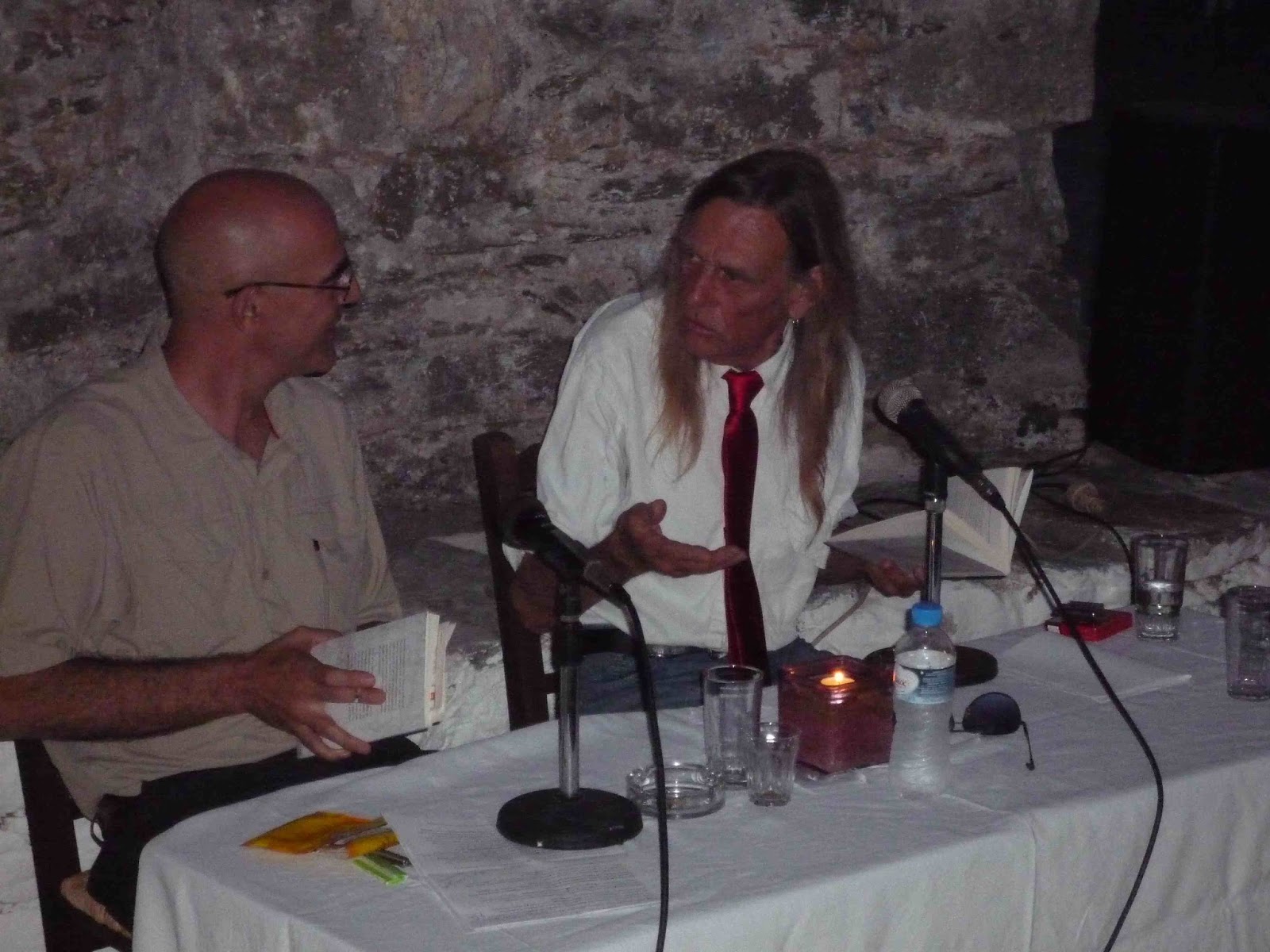
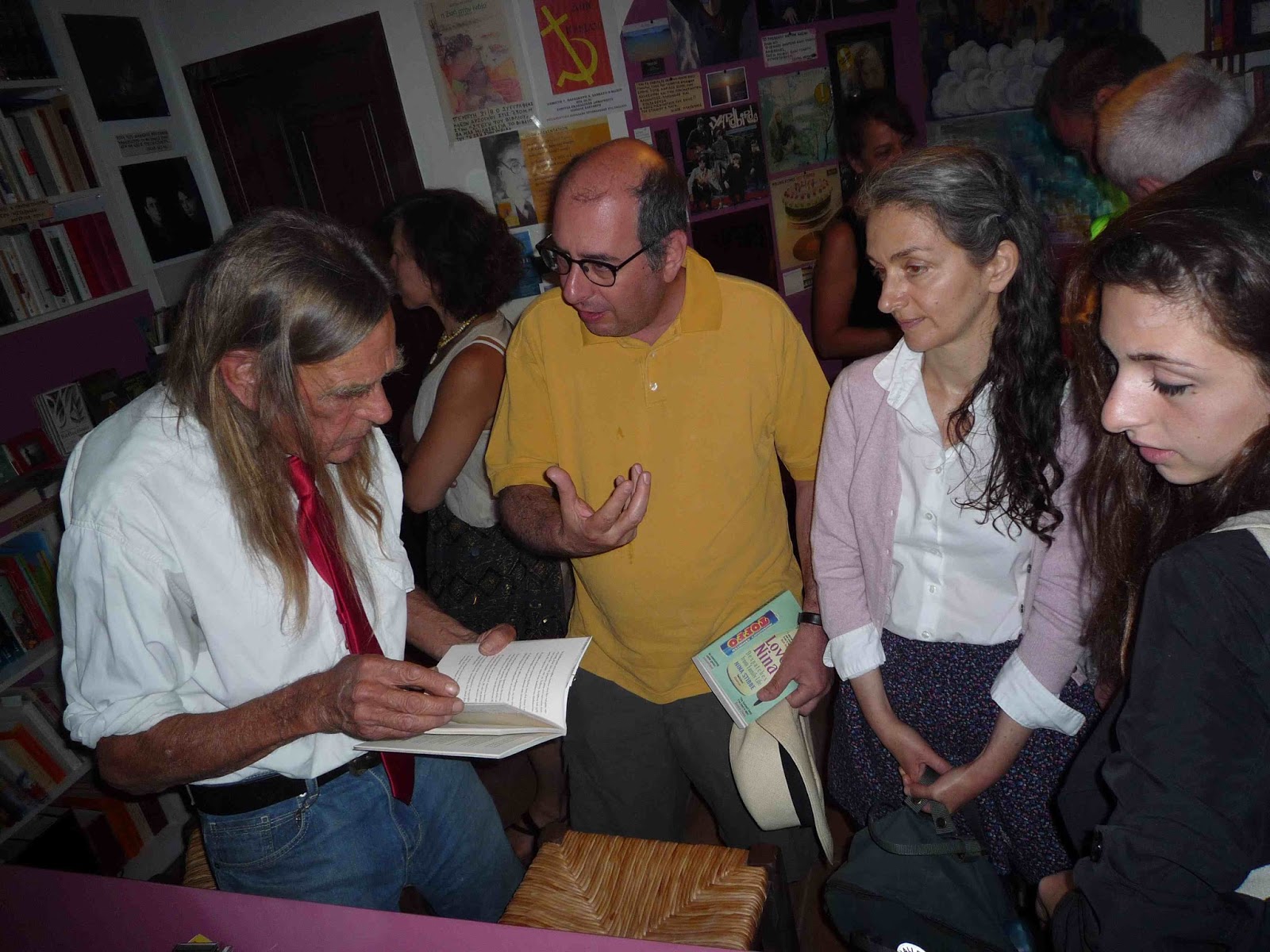
Here are some pictures of the event: (At the table, the chap with very little hair is the publisher, also called Laskaratos, and the chap with too much hair is me.)


Saturday, 11 July 2015

El Greco’s Anamorphic Figures


Everybody knows one or two paintings by El Greco, with their strangely tall and thin people, like a TV picture when someone hasn’t found out how to set the aspect ratio properly.

El Greco — real name Domenikos Theotokopoulos — was, as his nickname suggests, a Greek living in Spain.

Philosophers, art critics, neurologists, ophthalmologists, all sorts of people who ought to know better have assumed that El Greco had ‘something wrong with his eyes’; more specifically, that he actually saw people (and presumably other things) as taller or thinner than they ‘really’ (i.e. according to the rest of us) were. Surprisingly few people are capable of thinking things through: one can perhaps forgive the art critics, neurologists, and ophthalmologists, but not surely the philosophers; the specialists in thinking.

Think about it. Suppose you were a painter, and you wanted to paint an accurate —more or less photographically accurate — picture of the scene before you. Surely you would paint so that, when you looked at your picture, and then at the scene it represented, what you saw was much ‘the same’: the picture, and the scene, would have the same proportions, and any anamorphic distortion in your vision would be constant, whether you were looking at the scene or the picture: it would be entirely irrelevant; the picture would have the same proportions as the scene, assuming that you knew (as El Greco did in Spades) how to paint. What’s more, anyone else looking at picture and scene would see the same proportions. As I say, think about it: carefully and hard.

The fact, surprising to some, is, then, that anamorphic distortion in a painter’s vision will have not the slightest effect on his picture’s proportions.

Oh, and yes: he was a wonderful painter.


I couldn’t find the title of this one, but it must surely be St Martin; the Roman Officer who cut his cloak in half to clothe a beggar.

Wednesday, 8 July 2015

Scapegoat


It has been known since the time of Keynes that Austerity is not the way out of economic collapse; that, indeed, it only makes matters worse. So why, even now that Greece has clearly said ‘We won’t take this shit any more’, are Merkel, the European Central Bank, the IMF etc., still trying to push Greece into even greater misery?

It’s called ‘Projective Identification’ and is well-known to psychologists — especially of the analytic school — and laughably easy to identify in the behaviour of unpleasant people of limited imagination, intelligence, and insight. Rather than admit their own stupidity or naïvety, people look round for someone else to blame. They become spiteful, cruel, vindictive, and of course do great damage to their own souls. In the present case they justify their behaviour by saying that easing matters, writing off some of the debt, co-operating with Syriza’s suggestions for new ways out, would set a bad precedent for other European countries in difficulties. ‘No, we must punish Greece hard,’ they say, pretending, as believers in the efficaciousness of punishment usually do, that it hurts them even more than it hurts Greece. (Something it may end by doing.)

So the Greeks have become the latest in the long line of scapegoats. ‘It’s all the fault of the Assyrians’… The Philistines, the Albanians, the Armenians, the people who wear white socks with sandals… or of course the Jews?
 

Tuesday, 7 July 2015

Όχι Day Revisited


As I’ve mentioned before, on the 28th of October 1940, Greece — albeit through the medium of a dictator — said a firm ‘Όχι’ — ‘No’ — to the more powerful European countries which were trying to get Greece to behave in ways that suited them.

On the 5th of July 2015, Greece — this time the Greek people themselves — said a firm  Όχι’ — ‘No’ — to the more powerful European countries which were trying to get Greece to behave in ways that suited them.

The 28th of October has become a day of celebration of Greek Independence and National Sovereignty.  How about a second Όχι Day?
 

Monday, 6 July 2015

Why Did The Greeks Vote ‘No’?


And so decisively, and with such gusto and celebration. The following, which many of yesterday’s voters will remember from the excellent series (now of course superseded by a dull, dumbed-down version) of Junior School textbooks Η Γλώσσα Μου (My Language), might help puzzled foreigners to understand:
 

Sunday, 5 July 2015

No, Nein, Nyet, Non, Yok, Όχι.


On the 28th of October 1940, The Greek dictator Metaxas gave his answer to Mussolini (and thus in effect to Hitler) who had asked him if Greece would like to join what was known as ‘The Axis’. His answer was Όχι. And in case of any doubt, that is the Greek word for ‘NO’. Ever since, on that day throughout the country and indeed everywhere they are to be found, Greeks celebrate their independence, their refusal to let other countries tell them what to do.

Just thought you might like to know.

Saturday, 4 July 2015

Chinese as She is Translated


I have just bought — partly to use as intended, partly to open up, see how it works, and think up amusing things to do with it — a Chinese electric mosquito zapper. (‘Electric’ here qualifies ‘Zapper’, not ‘Mosquito’). Here is what it says on the box:


But I mock not; I laugh with rather than at. I couldn’t write instructions to boil an egg in Chinese. And anyway, when I took it to pieces I forgot that of course there were capacitors in the circuit, so even though it was unplugged I got a greater than 600 Volts DC electric shock, just like a mosquito. Καλά να πάθω.

Friday, 3 July 2015

Which kind of poverty will the Greek people choose?


Όποιος θυσιάζει την ελευθεριά του για την ασφαλειά του δέν αξίζει ούτε την μία, ούτε την άλλη. That has been said, in many languages and at many times, by many people, right back to the beginnings of human society. Among those who have said it was — (though in the current political climate it seems scarcely credible) — an American president; Benjamin Franklin.

I saw it painted up on the wall of the harbour workers’ union building in the Greek city of Volos a week or two ago. I hope lots of people did, and I hope they will remember it when they go to vote in the referendum (which, for their own reasons, the people who are trying to rule Greece from other countries are trying to get the Greek government to cancel) on Sunday. I’m afraid the choice is going to be between poverty and poverty. Poverty with independence, or poverty as the disgraced pet dog of International Finance.

Copyright is Indefensible


I don’t mean morally indefensible. That is something about which there is heated argument. I mean, literally, practically, impossible to defend. High-quality copying of printed material, recorded music, films, pictures, etc. is now something people can do at home, unobserved, and they do, and will continue to do so. And ‘people’ here does not mean just those who care nothing for the rights of writers and other artists; those who simply want to steal their work. I am am a member of PEN and of the Society of Authors, and even of the Authors Licensing and Collecting Society, which latter’s job is to collect and distribute to the original creator fees for legitimate copying. I care deeply about the right of creators to be paid for their work. Nevertheless, I do my best to get the works of other writers without paying for them, and I know that other people do the same with my work, and good luck to them — I want as many people as possible to read my stuff; surely all writers do? Though it does get up my nose when I see my stuff all over the internet but without my name attached, and some silly little blogger trying to take credit for what she didn’t write herself. But I don’t regard myself as the ‘owner’ of what I write: if something someone makes achieves the status of a work of art — and I believe just a few of my writings have done that — then that thing becomes everybody’s property, or nobody’s. God’s, if you like.

Until recently, writers and musicians themselves were the main defenders of copyright. Publishers, record producers etc. tried to get copyright assigned to themselves; to take it away from the creator, whom they tried to tell he didn’t need it, (The Guardian newspaper, of all people, still tries this on, I’m afraid,) but the publishers etc. wanted it because actually they knew it was valuable. Now, quite suddenly, they are the great defenders of ‘intellectual property rights’, but of course only because of their own ‘right’ to make money from our work.

The argument is presented unfairly: copiers are castigated, called thieves, but call themselves defenders of freedom.

But why should I, a writer, be against copyright? Because, as I said, it is indefensible. So do I care nothing for the ‘rights’ (that is to say, ultimately, the survival, the ability to make a living) of creators? On the contrary, I care very much.

So what would I like to see in place of copyright? This will be dismissed as hopelessly utopian; nevertheless: What I would like to see is an expansion of organizations like the Royal Literary Fund to a State level. The RLF already does excellent work in this field: I myself get a pension from them. This is how it works: writers applying for support from the RLF are asked to present copies of their work. A committee of, among others, fellow writers assesses literary — note, literary, not commercial — merit, and payments, often repeated, so amounting to a modest salary, are duly made, if you’re any good. ‘Good’; not, or not necessarily, on the front table at Waterstones because your publisher has decided it’s in his interests to bribe Waterstone’s to put it there.

And that, in outline, is how creators should be paid for their work. It shouldn’t, with such a system, then matter to the creator very much — in fact it ought to please him — if his stuff was got cheaply or free by the public, copied, sent to friends, posted on the internet, etc.

Thursday, 2 July 2015

Come into the Consulting-room, Maud


Here are the two first verses of Tennyson’s great, strange poem ‘Maud’:


How many normal people (as opposed to sex-crazed psychoanalysts) at once read here Tennyson’s terror of — er — the female pudenda, especially when menstruating? Yet how many of us, once having had it pointed out to us by some smart-arse literary critic (like me) can ever again read those lines ‘normally’?

Anyway, here’s a picture — taken, I believe, by Lewis Carroll — of Alfred Lawn Tennis Association himself:


Wednesday, 1 July 2015

Between Scylla and Charybdis


That is where Greece now finds itself, and with no navigable channel between them. It looks — for all that the wunch of bankers which is trying to rule Greece from outside is trying to prevent it, in clear contravention of national sovereignty — the Sunday referendum will happen.

So. The people of Greece will either vote ‘Yes’ — no doubt under the impression that they are simply voting to stay in the European Union, but in fact voting to accept even more austere austerity measures. In that case, Greece has before it a further hideous increase in deaths from suicide, starvation, exposure, and sheer misery.

Or they will vote ‘No’. In which case — though the rules for such an expulsion have never been formulated — ‘They’ will expel Greece, not from the Common Market, but ‘just’ from the common currency; the Euro. In which case Greece has before it a further hideous increase in deaths from suicide, starvation, exposure, and sheer misery.


A Question for Foreign Visitors to Greece


I have heard a number of visitors — not the long-term foreign semi-residents, nor yet the people coming to this island for the first or second time, but the ones who have been coming for their holiday to this same place year after year — complaining; saying such things as ‘We’re fed up with Greece putting its hands in our pockets.’

My question for these people is ‘Don’t you think that, over the years, and taking everything into account, Greece has given you more than you’ve given Greece?’