Friday, 3 January 2014

New Year's Resolution, with Reference to Rhinos


My New Year’s Resolution is to take a more objective view of the intelligence, taste, and imagination of myself, on the one hand, and of my readers, on the other.

Now. On the 9th of December last I posted here the first part of my story ‘The Replacement Rhino’. I said I would post further instalments if they were asked for. Nobody asked, so I concluded the story was no good and posted no further instalments. However, in view of the resolution mentioned above, I have now decided that the story, while hardly a masterpiece, is certainly good enough to entertain you lot out there, and that the reason the first instalment provoked no comment was that you are all dull, sullen, and unresponsive. So I shall continue quixotically to cast pearls, (never let it be said I don’t mix metaphors well), and today’s pearl is the next instalment of ‘The Replacement Rhino’. You will remember (No you won’t) that in their quest to find a replacement for the rhino lost by little Matilda, Frobisher and Caruthers have got as far as Marseilles, where Frobisher disappeared, failing to turn up at the Hôtel des Anglais for dinner. Now read on…

 --~--

It was with mixed feelings, then, that I saw Frobisher waving his fork cheerily at me across the dining-room when I came down to breakfast the next day. ‘I trust you had a pleasant evening,’ I said. ‘Oh, very jolly, very jolly,’ Frobisher replied, ignoring the frostiness of my tone; ‘You should try some of this,’ pointing his knife (using domestic utensils in this way is another of his vulgar habits) at an unappetising-looking plate: ‘Bloaters, with a side-order’ (I don’t know where he picks up these anachronistic expressions) ‘ of snails and frogs’ legs. Curious thing: Niko was telling me that the Greeks, too, eat snails, and I must say they’re on to something: very tasty, though I suspect the garlic has a lot to do with it.’ I turned away to conceal my rising gorge and signalled to the waiter, to whom I explained loudly and clearly the correct method of making a pot of tea. ‘Si m’sieu, si m’sieu’ he kept repeating. Ignorant fellow didn’t know his own language, and judging from the lukewarm grey liquid he brought me nor did he even understand English.

            ‘I, on the other hand, spent a most tedious evening,’ I told Frobisher. ‘Oh, really?’ he replied lightly. ‘Yes indeed. I was engaged in a tiring and unproductive search for a ship to take us across the Mediterranean,’ and unable any longer to contain my irritation I’m afraid I began to berate him for his frivolous attitude to our entire enterprise. He listened with what I would have taken for a remorseful silence were it not for his infuriating smirk.

            ‘Have you quite finished?’ he asked when I had at last done so. I nodded curtly. ‘Look here Caruthers old sport, don’t fret: it’s all sorted.’ (Another anachronism; even common people don’t yet use this expression.) It transpired that friend Niko had arranged for our passage, with the very ship on which he was an officer, to Djidjelli, of which unlikely-sounding place I had not heard, although Frobisher assured me it was a ‘very atmospheric’ little port on the Algerian coast. Free of charge, to boot: we were to be signed on as temporary crew members, ‘Though naturally, as gentlemen,’ Frobisher added hastily, ‘we shall not be expected to actually do anything. We sail at midday; better μαζεύουμε τα μπογαλάκια.’

            I lowered my gaze to the tablecloth — a mistake — and I fear a maidenly blush appeared on my cheeks. I suppose I am unjust to dear old Frobisher. For all his faults — and they are many — he can be resourceful just when one least expects it. I recovered a gentlemanly demeanour, raised my head and half stood to reach across the table and shake the old cove’s hand, now free of eating utensils. ‘Well done, Frobisher my dear chap! I expected nothing less of you!’ The mortifying fact was that I had expected a great deal less of him.

            The s.s. Cyrenia was a cargo ship, sailing empty to pick up dates or some such, consequently accommodation was limited and Frobisher and I had to share a cabin. Fortunately he spent most of the crossing out of it, (in more senses than one), with his friend Niko. Thus I was free to ponder again exactly where we should expect to find… Rhinoceri? Rhinoceroses…? True, we only needed one of them, but it would be a poor show were we to encounter two or more of the beastly things and not know what to call them. I considered. Ρίνος, nose. Κέρας, horn. Thus ‘Horn-nose’. The plural of Κέρας? I cast my mind back to the far-off days when old ‘Bod’ Bailey used to try to drum Greek noun conjugations into our dense unwilling skulls. Masculine nouns in –ας would surely take the plural –ατα. Yes, that must be it. Rhinocerata, that was what we were after. Didn’t sound quite kosher, but there was no sense in consulting friend Nikos as of course his Greek would be the vulgar demotic variety and not the proper Greek used in the better English schools.

            Matters of grammar having been temporarily settled I went for a brief stroll around the ship and came across, high up near the bridge and with its door hooked open — the temperature was increasing as we approached the dark continent and air-conditioning has still not been invented — our friend Niko’s cabin. He had one to himself as it turned out his job was to operate the recently-invented Marconi apparatus for sending messages without the use of cables, and this (which nevertheless seemed to have a remarkable number of cables) took up much of the space. The desk before it was strewn with reproductions of paintings, and there was a notebook for, I assumed, messages, but a closer look showed what appeared to be the beginnings of a poem; Niko’s was clearly a strange and disturbing character. A row of badly-washed underwear was strung across the cabin, and from this I averted my gaze until Nikos drew my attention to the copper wire from which it hung, explaining that this conducted the messages — one must hope that they were unaffected by passage through the underwear — from the apparatus to an ‘aerial’: a longer wire stretched high up between the two masts, indeed this seems to be the sole function of masts now that ships are propelled by steam rather than wind.

            ‘The messages are encoded in the Morse system,’ Nikos explained. ‘For instance, I might wish to send the message… er…’ ‘Dear Dot, must dash,’ Frobisher exclaimed from the bunk where unnoticed by me he was, as usual, taking his ease. I ignored him. Niko’s explanation of the Marconi apparatus was so absorbing — with much whistling and crackling a message came through, which he duly transcribed, while I was there — that I quite forgot to ask him in which part of Africa one might expect to find — er — rhinocerata. Being Greek he would be bound to have an opinion, however absurd, on the matter, but for myself I was beginning to have doubts as to whether we were even headed for the appropriate continent.

More soon, you lucky people.

Thursday, 2 January 2014

Shipping

A very short post today, simply to tell anyone who doesn't already know about a very useful and interesting website:
 marinetraffic.com
When you 'go to' (as they say) this site, you are shown a map of the world, into which you can zoom, and then you are told what ships are in that place, their exact position and speed and direction, the name of the ship of course, and even the names of the ship's master, engineer etc. It is updated every few minutes. For instance, five minutes ago (I am writing at 10.45 a.m Greek time) I zoomed in on this area and found that the ferry boat Proteus is currently stationary in the port of Glossa, en route to Volos.
Note that the site doesn't tell you where ships are 'supposed' to be, or what timetables and schedules say: it shows you (complete with a picture of the ship itself) exactly where the ship actually is, right now, which way it's going if it's moving at all, and all sorts of other details which you may or may not need.
It would in fact be possible - haven't tried it yet - using this site to sit at the cafe on the ferry-boat jetty and see if the ferry was in fact just about to appear round the headland, or was still in Skopelos, or was struggling to get across the strait between Agios Georgios and Kokkino.

Wednesday, 1 January 2014

Scrounging Foreigners


Dimitri writes to say he would like blog entries to be shorter and have a conclusion. Jane writes to ask just how it is that poetry decreases readership: surely people have already opened the blog before they discover that it contains poetry? She suggests that their computers may have a ‘Poetry warning light’. Another useful feature would be a ‘Bullshit detector’, but I fear it would be flashing all the time.

Today I want to talk about Bulgarians and Romanians. Journalists in such balanced and widely-respected British papers as the Daily Express and Daily Mail have, it seems, made a deep study of the cultures and languages of Bulgarians and Romanians, (let us call them ‘Bags’ for short) and have some alarming things to tell us.

Bags are not like other people. For one thing, they move around, all together and at high speed, in ‘hordes’ or ‘waves’ or ‘floods’. And Bags are all liars: they say they want to move around Europe in search of employment, but in fact they are all haring straight across Europe to get into England, where they have no intention of working; they are going to claim benefits. (Well at least then they won’t be ‘stealing our jobs’, as some people have feared.)

There have been hordes, waves, floods, whatever of immigrants to Britain before. Every time there have been warnings of dire results. Every time, the result has been an ‘Improvement in the economy’. (I’m never quite sure what that means, but apparently it’s a good thing.) Sure, some of them become ‘Benefit Scroungers’, just like many native Britons. Most want to work, and many, in spite of discrimination, succeed in finding work. Very often they do the jobs native Britons don’t want to do.

What about the ‘Benefit Scroungers’? It seems the government compiles statistics about people receiving Social Security benefits. The percentage of claimants who have come into the UK from other countries has never, not even just after another horde of foreigners has arrived, risen above two percent.

Tuesday, 31 December 2013

Well tell me then


Well that really worked a treat. There’s a thingy on my blog that tells me how many people are looking at it, (though not, you will be relieved to hear, who they are,) and so now I know that putting a poem in, or just mentioning poetry, causes the readership to plummet.

The trouble is the absence of what is now called ‘Feedback’. In spite of repeated invitations to do so, with the honourable exceptions of you, Dimitri, and you, Jane, no-one ever writes in to say ‘Well that was a load of old codswallop’ or ‘Gosh that was fascinating.’ It’s like the stand-up comedian’s nightmare: the sullen, unresponsive, indifferent audience. Far better the shouts of ‘Boo! Get off!’ and the bad eggs and rotten tomatoes hurled from the gallery.

So if you won’t tell me what you’d like me to write about, I’ll just have to guess. Today’s subject is the corpuscular theory of light. (I can almost hear the eager chorus; ‘Great! At last! A subject of wide general interest!’ Well tell me then.)

            The atoms of Democritus
            And Newton’s particles of light
            Are sands upon the Dead Sea shore
            Where Israel’s tents do shine so bright.

That’s William Blake. (I think I’ve got it right; I’m quoting from memory.) John Keats too, who with his medical training should have known better, thought Newton had destroyed the rainbow by analysing it. In Newton’s time natural philosophers (what we should now call scientists) argued over whether light was made of particles or was a wave motion. The argument continued until the twentieth century, when some peace-loving person came up with the notion of a ‘Wavicle’. Sometimes light is a wave, sometimes it’s a stream of particles. Actually of course it’s neither; light waves or particles have no more ‘real existence’ than do lines of longitude. We would be all at sea without lines of longitude, (if you work for the BBC you must pronounce it ‘Longditude’, just as you must pronounce ‘Antarctica’ as ‘Antartica’ and ‘February’ as ‘Febury’ and ‘Medicine’ as ‘Med-sun’. Sorry; end of irrelevant rant) but I don’t think transatlantic liner passengers were ever disturbed by the ship’s bumping over a line of longitude like a train bumping over the points. Scientific theories are just fantasies, but fantasies with explanatory value.

Newton, rather to the surprise of later theoretical physicists, went for the ‘Corpuscular’ (Particle) theory of light: light as a stream of little balls, bouncing off things or going through them and entering our eyes. The idea makes a lot more sense than it might seem to, in fact it’s helpful in understanding how magnifying glasses, microscopes, and even electron microscopes work.

So, on the corpuscular theory of light, how does a magnifying glass or a microscope work? The best analogy I can think of today (I’m not feeling too brilliant but nor it seems is anyone else in the island; you could hardly get into the doctor’s waiting room this morning so I gave up and went away) is a slide projector, of the sort with which people used to bore their dinner guests rigid (‘That’s me and Mavis coming out of our hotel’) before everyone had computers. Suppose you want to examine the fine structure of something or other. You take a very thin slice of it (microscopists use microtomes, which have blades from cut-throat razors, or pieces of glass or even diamond) and put it in the slide slot. Then you bombard it with particles of light (the projector bulb) and put a screen in front. Where the light particles hit something solid in the sample, none of them reaches the screen. Where they get through gaps, they do. (Duh.) So on the screen is a blown-up representation of the sample.

Now there’s a limit to the blowing-up. What happens if we want to see the really fine structure, what is called the ultrastructure, where the gaps between the solid bits are smaller than the particles of light? Well you can’t. It would be like expecting tennis balls to go through the net. That’s that. Microscopes just can’t go beyond a certain magnification. For a long time it was thought we could never never see the really fine structure of cells and so on; we made it all up and amazingly (as it turns out) got a lot of it right.

But hold on: tennis balls? Suppose we were to use ping-pong balls? Not much use for tennis, but they would go through the net surely? And that’s where the electron microscope comes in handy. Instead of great big ‘Photons’ (as particles of light are called) we use electrons, which are very tiny indeed. So tiny that in order to see them you would need …  


Monday, 30 December 2013

No Blog Today?

Something called 'Overview' tells me that 70 odd people look at my blog daily, but I sometimes wonder if it's the same two people - Dimitri and Jane - who look at it 70 odd times a day. So I get discouraged and sometimes fail to write anything. Dimitri has just sent me the following message; I hope he won't mind my putting it in here. Dimitri is Greek of course. How many English people could send me an e-mail in Greek verse?

No blog today
Are you ok?
What happened while I'm away?
Was the day pale and grey?
And if someone has caused you trouble,
when I'll return I'll give him double.
Did you visit yorgo? friend of mine
I hope that you're doing fine
 
I do have something in process of being, slowly, written, and I promise it is not a poem or about poetry. Be patient.

Sunday, 29 December 2013

Another go at reducing my readership


Meaning in Poetry

‘Poetry is not made out of ideas, it is made out of words.’ Thus Mallarmé to Degas. A straightforward enough truth, but one often ignored or misunderstood. Shelley ignored it in his more overtly political writings, and so have countless propagandists before and since. The results are always dire — they may be verse, but never poetry — however much we may sympathize with the ideas expressed. What confuses the issue is that some of the writers of such verse, for example Shelley, were also poets, whereas most of them never were, because they thought poetry to be merely one of a number of possible vehicles for ideas. They had forgotten, or never knew, that the words come first.

A more interesting ignorance or misunderstanding is that which takes Mallarmés dictum and jumps to the invalid conclusion that the meaning doesn’t matter. That something comes second, or third, or twenty-sixth, doesn’t imply that it doesn’t matter; it may turn out to be what matters most: poetry is not a competitive sport. It’s just that in the normal course of affairs, when we are not writing, reading or hearing poetry, we have ideas and find words to express them. In poetry we have words and find that they express ideas.

What about Nonsense Poetry? In most cases it isn’t nonsense. There was, and probably is, something called ‘Concrete Poetry’, made of sounds rather than words. Good luck to it, and of course it may call itself what it likes, but it is probably more helpful to think of it as scat-singing without the tune than as poetry. What we think of as ‘Nonsense Poetry’ — Lear, Carroll, or in German Morgenstern and Ringelnatz — works so well precisely because of its ties — flexible but definite — to sense. Take, for example, the first verse (later verses are much less nonsensical) of ‘Jabberwocky’:


’Twas brillig, and the slithy toves
Did gyre and gimble in the wabe;
All mimsy were the borogoves,
And the mome raths outgrabe.


This is by no means nonsense. It uses a lot of made-up words, but they are recognizably words, and (pace  another of Carroll’s creations) it is as true of made-up words as of dictionary-words that they can’t mean whatever one chooses. Their meanings may be subject to differences of opinion — that is true also of dictionary-words — but they are delimited by the words’ sounds, their resemblances to ‘real’ words, their endings, and — perhaps most importantly, at any rate in English and German — their positions in what are recognizably sentences.

I want to examine more closely the verse just quoted. If the reader has borne with me, I think he will agree with much of what I say about it. If I have irritated her, she will perversely deny what I offer. Or one will prefer other interpretations, but in all cases I think they must admit that, even in the extreme case of Nonsense Poetry, meaning is vital.

 ’Twas brillig  This is clearly a statement about the weather. Bright and sunny, perhaps rather oppressive. If the BBC weather-man were daring enough to tell us that it will be brillig tomorrow, we should all understand.

and the slithy toves  Toves are some sort of living creature, plant or animal, and there is more than one of them. And they’re slithy: ‘slithy’ is obviously an adjective, or rather one of those adjective-y words — I can’t remember what they’re called — like ‘runny’ or ‘grassy’ — derived from verbs or nouns. Slithy things slithe; they are sly and/or slippery, like snakes or fish.

Did gyre and gimble  ‘Gyre’ is a perfectly good dictionary-word, and it’s been used by other poets. To gyre is to turn, about either one’s own axis or an external one; in the case of Yeats’s falcon, in an expanding spiral. As for ‘gimble’, gimbals are the double swivels in which compasses, lamps and what-not are slung on board ship, so that they remain vaguely level when the boat rolls and pitches. From within the moving boat, and taking it as one’s reference, the gimballed object wobbles about with a motion that might well be called ‘gimbling’.

in the wabe  Fair enough, I’m not sure about ‘wabe’. It’s perhaps a swamp or marsh, or maybe a glebe, of the sultry sort in which one faints.

All mimsy  We all know what ‘mimsy’ means. Pansies are mimsy, so is Violet Elizabeth Bott in the ‘William’ books.

were the borogoves  Borogoves are surely some sort of single-stemmed multi-bloomed flower, between foxgloves and hollyhocks.

And the mome raths  Mome raths are larger, darker creatures. Perhaps trees, perhaps something like mammoths. Faintly sinister.

outgrabe  Clearly a verb, and clearly (from the ‘out’) expressing an extreme action. Also clearly in the past tense. ‘Outgrobing’, if that is the present participle, is just the sort of thing one might expect mome raths, with their finger-like twigs, or twig-like fingers, to do.


You see? Oh, come on.

Saturday, 28 December 2013

Sestina

Today, a poem, though I am well aware that by posting a poem on my blog I am almost certain to lose at a stroke the recent large and gratifying increase in the number of 'Page Views' as they are called.
This poem is a Sestina. As with most poetic forms, reading the dictionary definition of 'Sestina' is utterly bewildering, and even if one understands the definition one is likely to think 'Why on earth would anyone bother'? Nevertheless, here is a sestina. I might say (in fact I will say; surely one can blow one's own trumpet on one's own blog?) that this particular sestina won me a £500 prize. If the print has come out too small to read, I think you can make it bigger by clicking on it or something.


Friday, 27 December 2013

By their works shall ye know them


Footballers without two brain cells to rub together appear on television and are asked their opinion on the Palestine/Israel conflict. They’re famous, you see, and this apparently confers some authority. There are even people who seem to be famous for being famous, since they do nothing but appear on television and give their feather-brained opinions to an adoring public.

The effect of celebrity culture on literature is that writers are, for many members of the public, better known for their lives than for their work. People shed crocodile tears for Sylvia Plath because of her suicide, which they blame on Ted Hughes. How much of the poetry of either have they read, one wonders? Oscar Wilde? Oh yes; they sent him to prison for being gay. Didn’t he write a play or something? Etc. etc.

Many readers go more for the letters and biographies of writers than for the writings themselves, so I need to justify the inclusion of A Strong Song Tows Us, the life of Basil Bunting, by Richard Burton, (No, not the actor and not the explorer; this one is a publisher) in my list of much-wanted Christmas books. You see, I have read very little of Basil Bunting’s (gosh, I’m glad my name isn’t Basil Bunting) poetry; not even his masterpiece (so I’m told) Briggflats. Few but poets have even heard of Bunting; he has become a ‘Poets’ poet’, but respected critical opinion is that he was one of the finest English language poets of the twentieth century. Reading his work is something I’ve been ‘meaning to do’ (People say ‘I’ve been meaning to write’ as if that somehow excused their failure to do so until prompted) for a long time. So when I heard of this biography I asked for it, but I have resolved not to read it until I have first read Bunting’s poetry; there is bound to be some Bunting in my four shelf metres of poetry books.

So I’m afraid I can’t tell you, yet, anything about either Bunting’s work or his life. Just that the poetry is good.

—    ~ —

Today we celebrate the release from prison of Pussy Riot members Nadezhda Tolokonnikova and Maria Alekhina.


Thursday, 26 December 2013

Mega Biblion Mega Kakon


Now to the two remaining Christmas books, both inviting-looking fat tomes.

Reinventing Bach by Paul Elie. I don’t know what sort of reinvention he writes about, but 500 pages about Bach are surely a good thing. The great Cellist Paul Tortelier was once asked in a television interview who he thought was the greatest of all composers. ‘Bach of course’ he said dismissively and in a tone suggesting the interviewer was a moron, which he probably was. ‘You seem very definite about that.’ ‘Of course. Anyone who thinks otherwise is not a musician.’

There are senses in which every generation reinvents earlier composers, and in the case of Bach there is plenty of scope for this. At least in his clavier works, Bach used almost no phrase marks, legato and staccato indications, or dynamic markings. We can often guess at tempo because many pieces are headed ‘Bourré’, ‘Gigue’, ‘Sarabande’ etc.; dances whose tempi we know. Very often the score just has the notes, with the clefs, time-signatures and key-signatures, but he was often careless about putting those last three in and we need to work them out from a knowledge of the western tonal system. Interpretive traditions grow up, some of whose adherents insist that their interpretation is the ‘right’ one, but we can’t know, and listening to recordings over the last century or so we find huge differences.

Maelzel, inventor of the metronome, was a contemporary of Beethoven, and Beethoven enthusiastically added metronome marks to many of his pieces, so we have a guide to tempo, but there is evidence that Beethoven’s metronome was rather inaccurate.

Mozart is another case altogether: Ur-text editions show that Mozart himself usually put in dynamic markings, phrase and slur marks, staccato and legato, and so on. Should we slavishly follow them? Those who heard him play have said that he often played the same piece quite differently on different occasions. He may have had second thoughts, or he might have been saying ‘Look, don’t bother too much about those marks; try it different ways.’ But even if he had been consistent in his interpretations and demanded the same from other players, there is still a case for reinventing him. Frank Zappa, a very accomplished musician who should have known better, complained that Mozart was ‘predictable’. He wasn’t. Hearing a piece of Mozart for the first time (though it is rarely in fact the first time — one has usually heard the piece before, if inattentively, and has then ‘forgotten’ it —) one simply could not guess ‘what comes next’. What happens is that when one then hears what does in fact come next, one says ‘Ah yes, of course.’ That is not predictability; that is the inevitability of perfection.

Even so, certain short phrases of Mozart’s, often those marking a return to a main theme, have become clichés through being heard again and again. I think particularly of the melody line, in many of his piano sonatas, falling chromatically from the dominant to the mediant. That may well have seemed very daring and original in Mozart’s time but, especially when played legato as it almost always is, it now provokes an ironic ‘Da-da-da’ from the more irreverent in the audience. The originality of the phraselet can I think be partly recaptured by playing the notes well-separated, non-legato. I think this is legitimate, for all that it goes against Mozart’s own legato marking. It is even, in a sense, faithful.

But back to Paul Elie’s huge book. I don’t yet know what sort of reinventions he writes about. One thing I notice, skimming through, is the absence of musical examples. Perhaps they are not needed for what he is writing about, but there is always the suspicion in such cases that the publisher asked him to avoid them as they might put off people who can’t read music. The logical progression of that idea would be the avoidance of long words; no doubt people are already ‘writing’ books that consist entirely of ‘Emoticons’ and text message abbreviations. Good luck to them actually, provided it doesn’t lead to nobody any more being able to read Middlemarch or Ulysses. But it is extraordinary the lengths to which people who claim to be interested in music will go to avoid learning to read standard musical notation, and the lengths to which writers and publishers will go to pander to their ignorance and laziness. An ability to read and write music makes discussion of music so much clearer and easier.

As I say, it’s quite likely that little of the above is relevant to Paul Elie’s Reinventing Bach. I look forward to reading it and finding out what sort of reinvention(s) he has in mind.

There remains one even huger book to write about, but it must wait.

Wednesday, 25 December 2013

Christmas Books


My family in England has generously sent me two big boxes of books for Christmas. So in the best tradition of reviewers and blurb writers, I shall tell you about them before I’ve read them, starting with the smallest (132 pp) and ending with the fattest (618 pp).

Ex Libris by Anne Fadiman is subtitled ‘Confessions of a Common Reader’. She probably had in mind Virginia Woolf’s collection of essays ‘The Common Reader’, but it is nothing like that book — well, not much. It is much more, to use a hideous expression much loved by the BBC when it proposes to bore us with trivia, ‘Light-hearted.’ But this is interesting trivia; anecdotes about things found in books, (marginal notes, kippers), typos or rather ignorances in menus in foreign restaurants, (Greece is rich in those,) the cruelties people commit on books as physical objects, the delight of children in cruelties committed by story characters, and many other things to please enemies of the Kindle. Anne Fadiman is someone who loves books; real books.

Why Read the Classics? by Italo Calvino, translated by Martin McLaughlin, tells us why. This was not I think intended by Calvino to become a book; it is a collection of essays on ‘Classics’, using the word in the older sense. Nowadays anything over a year old that hasn’t been thrown out is called a ‘Classic’: this book itself is so labelled. (Thus one has to read it to find out why one should read it.) Calvino’s essays here however range from Homer, through Ariosto, Cyrano de Bergerac, Voltaire and Diderot, then Tolstoy, Hemingway, and (only now pushing the edges of the term ‘Classic’) ending with Raymond Queneau and Cesare Pavese.

Next, Gabriel Josipovici’s  Infinity, the Story of a Moment. Josipovici is sometimes so obscure that one wonders if he is putting it, and us, on, but this looks promising: it comes under the broad heading ‘novel’ and consists of a long interview with a fictional composer, in fact based on Giacinto Scelsi, of whom even music lovers such as myself can I think be forgiven for not having heard. Without, as I say, having yet read it, it looks as if it will turn out to be a rambling reflection on music and related subjects, with the ‘Novel’ structure as its alibi. A very handy literary trick; I used something similar in my ‘Anatomy of Wireless’ (available free to anyone who asks), which purports to be, and indeed contains, a technical history of the development of Wireless Communication, but is also an excuse for talking about Proust, feminism, life, the Universe, and everything.

Next, Monsieur by Emma Becker, translated by Maxim Jakubowski, whose name does not appear, as it should, on the cover. This is a novel dealing with that politically incorrect and therefore very attractive subject, a sexual relation between a very young woman and a much older man. It is interesting that of the three novels on this theme that I have read, two have been written by women, and only one of them, the one written by a man, (Nabokov’s Lolita), showed any serious disapproval of the man. Will this one ‘redress the balance’? What balance? What have novels, or life come to that, to do with balance? Anyway, it will probably be the first of my new books that I read; it has been months since I read a novel, and this one, at 370 pages, will (if it’s any good) be just right for the season.

Now to the heavy stuff. I have a long-term interest in Freudian psychoanalysis, both as a theory of the mind and as a therapeutic technique. There probably cannot be ‘objective evidence’ for the ‘actual existence’ of such things as the unconscious, the super-ego, etc. — it’s hard to see what could count as evidence, or existence, for mental (as opposed to physical, brain) entities. But theories are just that; explanatory constructs implying no entities.  I also have a long-term interest in Marxism. In fact I ‘believe in’, as one says, both Freudianism and Marxism. So V.N. Voloshinov’s Freudianism, a Marxist Critique, translated by I.R. Titunik  should be a treat, even if (perhaps especially if) it attacks long-cherished beliefs. The blurb suggests that, if I agree with what he says, I should in consistency abandon either psychoanalysis or Marxism. In fact I hope and intend to hang on to both.

Slightly lighter (I would guess) is a book of essays by the psychoanalyst Adam Phillips, One Way and Another. These are on subjects of such wide general interest as Tickling, (about which he has apparently also written an entire book), Clutter, and Talking Nonsense (and Knowing When to Stop. I had better read that first.) Psychoanalysts can often be very funny. Sometimes even intentionally so.

That’s enough, indeed probably more than enough, for today. There remain two really huge tomes, but I shall write about those another time.

Once again, Merry Christmas.


Tuesday, 24 December 2013

Alan Turing

Just one quick brief post today, Christmas Eve. Alan Turing has been given a 'Royal Pardon' for his conviction for 'homosexual activity'. Much good may it do him; he's been dead a long time. Not that such pardons should not be given; they pardoned Timothy Evans many years after they hanged him for murders he didn't commit. But pardons don't exonerate the people who, and the state which, fitted up poor daft Timothy Evans and hounded Turing (who was naively open and honest about his homosexuality) to probable suicide. No-one should feel smugly that 'Justice has been done.'
It has been calculated (God knows how) that the work of the people at Bletchley Park, notably Turing, shortened WWII by several years. It was they who broke first the Enigma code and later more complex codes; work which led to the development of computers.
If anyone wants to know how an Enigma machine works, I'll make it the subject of a future post. Up to now, I have been highly impressed by the intellectual acumen of my readers: not one of them had the slightest difficulty understanding that poem about people waiting to get into heaven, and I fully expect no-one to write in to say they don't know how an Enigma machine works.

Happy Christmas!

Monday, 23 December 2013

Poetry Schmoetry


I was writing the other day about how, and why, poetry is sometimes ‘difficult’. Here is an example:


Saxophone Schmaxophone.


Heaven’s ante-chamber: Eliot (Tom)
silently observes recursive time
defragment the past – now Webster (Ben)
plays his tenor sax for Webster (John).


‘Dead cold metal warms with breath’ says Ben
‘Hot flesh hides the icy bone’ says John
‘You two guys need wood’ says Johnny Dodds
Eliot in his corner smugly nods.


Adolphe (conic bore) says ‘Stuff’s a fetish:
wooden sax? It’s still a saxophone;
metal clarinets sound clarinettish:
what you hear is cylinder or cone.’


Let Ellington, more abstract still, construe it:
‘’Tain’t what you do,’ he says, ‘but how you do it.’


If no-one writes in to ask ‘What the hell was that all about?’ I shall assume that either every detail is crystal clear, or that no-one out there gives so much as a nun’s wimple.

Sunday, 22 December 2013

Merry Christmas


A Merry Christmas

to

Both my Readers.

May the young lady below come to fill your stockings.
 

Saturday, 21 December 2013

Some of these Days

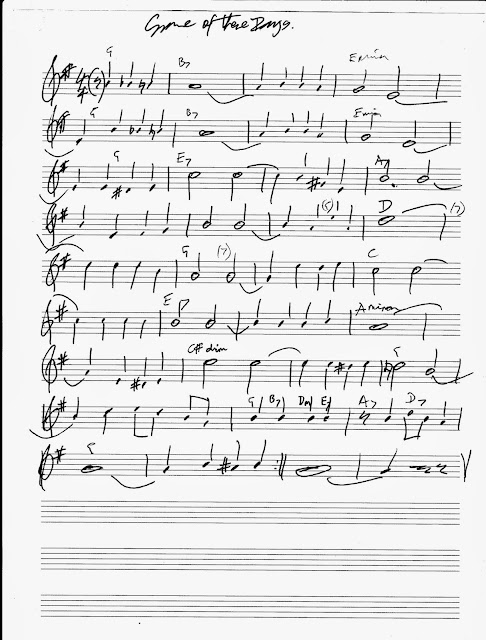
The golden age of American popular music - not just jazz, but the popular songs even people who didn't like jazz listened and danced to, and which were often then taken as vehicles by jazz players - (Jazz is omnivorous) was the first half of the twentieth century. A common feature of these songs is daring harmony; quite often the melody note is accompanied by a chord to which it doesn't even belong. I first noticed this - though I must have semi-consciously enjoyed it thousands of times before; most people are not conscious of more than the melody, though the harmonies are working on them - in Kurt Weill's 'September Song', but yesterday I was looking at 'Some of these Days' (incidentally a favourite of Jean-Paul Sartre's, though that may not be a recommendation) and saw it again. Here's the melody line, with the chords (I have left out a few inessential ones) marked above:
We're in G major, and the first change is to the mediant major chord (with a seventh.) It fits the melody, and is a change well-known to players of American popular music. Used judiciously it never fails to do something to us; it hits a spot the obvious harmonization with the tonic chord can't reach. You hear it right at the start of, e.g., 'Nobody knows you when you're down and out' and 'T'ain't nobody's business if I do.' Players of more folkey guitar styles will know it as the change that happens when you reach the refrains of 'Freight Train' and of 'Cocaine'. People of a popular 'classical' taste will know it from the third, the best-known, of Liszt's 'Liebestraume'. (Sorry; the blog window doesn't seem to allow for umlauts.) So far so (fairly) conventional. But look at bar ten, where the melody goes up to a C, but the chord underneath it is an E7th, none of whose notes is a C, and anyway it would have (to match E) to be a C#. What was the composer thinking of? Well evidently he knew what he was about, because even, or perhaps because, it breaks all the rules, it sounds great. And then, two bars later, he hits us with an A7th under the melody note - a sustained one, as before - of B. This is not too outrageous; it makes a 'ninth' chord. But it's certainly not the obvious choice. Now look a couple of lines further down: a repeated  long E, so one expects the subdominant C chord, (or, if one is beginning to expect the unexpected, perhaps an E7th again.) But what we get is that most dramatic of chords, a diminished 7th, the one that runs C#-E-G-Bflat. (Since diminished sevenths divide the octave into four exactly equal steps, there are only three of them). Then right near the end, the coup de grace: the melody is, here, simply repeated crotchet Bs, but the chords under them are G, B7th, D minor, and E7th. Fair enough, the note B is in three of those, and the E7th takes us nicely on to an A7th, which then resolves onto the dominant seventh, D7th, so that we can hit the repeat bar on the tonic and go back to the top again. But D minor? Totally out of order, but, yet again, it sounds great.
People such as myself and, I hope, a few others of an analytic (did someone say 'pedantic'?) turn of mind like to know, as far as it's possible, (which admittedly isn't very far) just why the music that sounds great does so. I have heard even accomplished musicians say that such an analytic approach must surely reduce one's true enjoyment of the music. Keats, who with his medical training ought to have known better, made a similar complaint about Newton's analysis of the rainbow. No; knowing how things work increases one's joy in them. 

Friday, 20 December 2013

Why is Poetry so Difficult?


King James said of John Donne’s poetry that it is ‘Like the peace of God — it passeth all understanding.’ Even now, four hundred years later, many people find Donne, and indeed poetry in general, ‘difficult’, and so avoid it. ‘If they can’t say what they mean and mean what they say in ways us lesser mortals can understand, then to hell with them’.

But there are good reasons why poetry — real, good poetry — is difficult. Two of the essential qualities of poetry are concentration — using as few words as possible — and operation at the borders of language: finding new ways to use words, so as to say things that could not be said with a more straightforward use of language. Of course, that breeds charlatans, who write pretentious incomprehensible rubbish, and even get published, paid, and praised on the emperor’s new clothes principle — those who don’t understand it pretend they do lest they be thought philistine. And there are the dangers that a pioneering poet might stray too far into unknown territory and lose his readership, and the opposite one that in an attempt to be ‘accessible’ he writes mere trivial verse. There are also those (like myself, but also like William Empson, a very fine poet) who use their poems to show off arcane knowledge. But a good poet will usually try to be as clear as possible, even though he is trying to say things that have not been, indeed could not have been, said before.

If nothing else comes up before then, I’ll go through an example or two tomorrow.

Thursday, 19 December 2013

The Economic 'Crisis'

As all English speakers know or ought to know, a crisis is something instantaneous or nearly so: some process continues until it reaches its zenith or nadir, (the 'crisis'), and then there is a sudden change and things are completely different. Illnesses are commonly said to reach their crisis; the patient, or his fever, gets worse and worse, the crisis is reached and then he either dies or starts to get better. A crisis is like the sharp edge of an escarpment, or the point at which an aeroplane, rising steeply, suddenly stalls and swoops downwards. Thus what is happening in Greece and other third world countries that happen to be in Europe can not properly be said to be a crisis. 'Properly'? Nowadays majority usage is what determines meaning, and as usual ignorance rules OK, so crisis is the word we have to use for the worsening states of affairs in these places. Another good word done gone.
In small isolated communities, where everyone knows everyone else, things have not been so bad. No-one is allowed to starve or to have no roof over their heads. Such a place is this island where I spend most of my time, with a population of around 2,000, so that we rarely have need of the formal Σας rather than Σου, equivalent to the French Vous and Tu. We all know each other well enough; only too well in some cases.
What is noticeable here though is how empty of goods the shops are getting. Wholesalers now demand payment in advance even from long-established customers; all too often businesses have collpased and the owner become bankrupt or simply disappeared, perhaps to be found later shivering in an Athens underpass waiting for some charity to pass with a cup of soup. Suicides, especially of previously successful businessmen with families they are too ashamed to admit they can no longer support, have increased. But I'm getting too sad and serious for what I wanted to say, which was just about the downward spiral of available foods for those who have the money to buy them:
Because of that demand for advance payment, shopkeepers are slow to replenish depleted shelves. They haven't got the money to pay for things that might take a while to sell, and, especially in places like the islands, where everything comes by ship, orders must be large before the wholesaler will bother to deliver. So as the shelves of their favourite shop empty, people stop going to that shop - which therefore gets even less money - and go to another better-stocked one. Until the same thing happens there. So shops close, one by one, the smaller ones first, and only the big well-off ones survive. The little shop where one was a close friend of the owner, and she always made sure to keep a bottle or two of the special ouzo you liked but few others bought, or your favourite but unfashionable cigarettes, (Note that I am speaking here just of essentials) has gone; you will have to drink the mass-market ouzo the big shop has, and smoke Marlboro.
It's called Capitalism.

Wednesday, 18 December 2013

Further Operatic Silliness

I mentioned 'Cosi fan Tutte' yesterday. It is generally reckoned to be one of Mozart's best operas, yet it has a plot almost as silly as a message on Facebook.
The title 'Cosi fan Tutte' is difficult to render in English: something like 'They all do it' or 'Thus do they all', but Italian being an inflected language the grammar shows that the 'They' who do 'it' are women.
Two young men are boasting to each other of the virtues of their girlfriends: how beautiful, how devoted, and above all how faithful they are. As is the way with idiotic young men, each insists that his girlfriend is in all respects better than his friend's. They are interrupted by their cynical old friend Don Alfonso, who tells them their girlfriends would betray them at once if they got the chance. Much indignation, and finally they lay a bet on it. 'But', says Don Alfonso, 'You must follow my instructions to the letter'.
Don Alfonso goes off to see the girlfriends, who conveniently live together, in fact I think they are sisters. He brings them the dreadful 'news' that their boyfriends have been called up and must go abroad to fight the Turks. The boys turn up with military uniforms and long faces, then set off to catch the boat. Don Alfonso and the two girls sing the trio 'Soave sia il vento, tranquillo il mare' (May the winds be gentle, the sea calm.) It is typical of Mozart that this heart-breakingly beautiful trio is sung by a cynical old deceiver and the two airheads he is deceiving.
The boys gone, the two girls sit around drinking hot chocolate and bemoaning their fate, until their maid Despina (suborned of course by Don Alfonso) suggests they divert themselves with a couple of nice young men from the invading Turkish army. Don Alfonso duly supplies two nice young men, who are of course the original boyfriends in Turkish disguise, and each of them sets about trying to seduce the other's girlfriend. At first they are unsuccessful, much to their secret delight, but Don Alfonso gets them to fake depairing suicide, from which they are revived by a pupil of Dr Mesmer (In most productions 'he' wields an enormous horseshoe magnet; it is of course Despina in drag) and the girls relent. A double marriage is arranged, each 'Turk' marrying the (real) other's (real) girlfriend. Just as the notary (Despina again) is reading the marriage contracts, Don Alfonso dashes in to warn that the original boyfriends are back from the war. The two Turks rush offstage (to do a quick costume change into their original gear) and come back on as 'themselves'. They 'Discover' what has been going on, but everyone lives happily ever after and the girls are forgiven: Cosi fan Tutte after all.
And this outrageous mean calumnious sexist trick is what Mozart chose to hang one of his finest operas on. But: The music is beautiful.  

Tuesday, 17 December 2013

The Absurdity of Opera

I made a sort of Christmas resolution to write something in this blog every day, in the hope that a few people might start to look at it. Today, here in the Northern Sporades, it has been damp and dreary; It is already evening and I didn't write anything. So here, unrehearsed, and provoked simply by what I said of Beethoven's 'Fidelio' yesterday, are a few random thoughts about opera.
I can sympathise with those who think they can't stand opera. For one thing, the ludicrous plots, whose idiocy shows in concentrated form in the synopses in sleeve-notes for CDs: 'Meanwhile the count, disguised as a student, is climbing up to the balcony of Despina the servant...' The way any dramatic action is interrupted by the 'necessity' for a character to come downstage and sing a complete da capo aria. Above all, the ghastly shrieking of the huge sopranos in Wagner. (Like many who love opera I don't much care for Wagner except in theory.) To enjoy opera you have to suspend not just disbelief but a whole tranche (what incidentally is a tranche?) of critical faculties while sharpening various others.
Let us consider one or two plots. Verdi's 'Rigoletto' for a first example; an opera Nabokov dismissed as 'A packaging error'. Rigoletto the hunchback is the court jester. He has a secret; at home he has a beautiful young daughter of whom he is very protective. A nobleman gets to hear of this and sets about getting into the garden to seduce her, but to his surprise he falls, for the first time, genuinely in love. Meanwhile (opera needs lots of 'meanwhiles') Rigoletto, on his way home from work, encounters Sparafucile, a Iago-like chap with a splendid deep bass voice and who offers to do any murders Rigoletto might happen to need. When Rigoletto arrives home there is an ecstatic reunion of father and daughter which always makes me think of the joy of a dog who has been shut in the house all day while his master is at work. Dad pops off to bed and Gilda the daughter sings about just the beloved name of her secret lover, the nobleman. Her music is full of little jumps of an octave or a sixth, mirroring the light, skipping quality of the character: Verdi is a much more skilled composer than many think. But back to the silly plot: various worthies of the court, curious about Rigoletto's secret, are spying on her, and they kidnap her 'for a joke', tying her up in a sack.
'Meanwhile' Rigoletto has discovered that some chap is trying to seduce his daughter, and arranges for Sparafucile to do the necessary. A body-containing sack is duly delivered.
Well you've guessed the rest. Gloating over his sack, Rigoletto hears in the distance the seducer singing his trade-mark aria 'La donna e mobile', known vulgarly as 'Arseholes are cheap today, cheaper than yesterday...' So who's in the sack? Guess. With her dying breath Gilda of course sings a great big aria.
What utter nonsense. But the music is very beautiful. A friend of mine once found himself sitting at the opera next to the German composer Carl Orff, who said to him 'Oh, who cares what they're saying? I come for the music.' (I think the opera was Richard Strauss's 'Der Rosenkavalier' which marks the end (except for Puccini who is a special case) of the great romantic opera tradition: romantic opera fits neatly into the nineteenth century. In fact, at the end of 'Der Rosenkavalier' it comes full circle: the two young lovers, finally and unexpectedly coming together, sing their exquisitely beautiful duet 'Ist ein Traum kann nicht wirklich sein', and Strauss, for all his genius, comes up with a tune that could have been written by Mozart.) End of digression. What I wanted to say was that 'Rigoletto' can be read as a feminist text: an attack not just on the 'gay seducer' attitude to women, but more importantly on the overprotective attitude of fathers who keep their daughters locked up at home like dogs deprived of their freedom. Incidentally Gilda's mother is dead, and when Gilda has the temerity to ask about her Rigoletto responds with an aria about her being an 'Angel'. No doubt he also thought she was a virgin.
I was going to continue with a consideration of 'Cosi fan Tutte', which many consider Mozart's greatest opera. This has a plot of such outrageous sexism that it demands a whole essay, and it's time for coffee, piano practice, whisky and bed.
But to repeat: The music is very beautiful. 

Monday, 16 December 2013

Infidelio


In a recent production of ‘Fidelio’ a string quartet descended from the flies in wire mesh boxes, playing — no, not John Cage, but a movement from Beethoven’s own late quartet opus 132. The TLS reviewer Guy Damman says it was the second movement, which seems an odd choice; I would have expected the third, the Molto Adagio in the Lydian Mode. But I wasn’t there and Guy Damman presumably was, and anyway he teaches at the Guildhall School of Music and Drama, so I suppose we must take his word for it.

Many people don’t ‘hold with’ this messing around with established works, but in the case of Beethoven’s (mercifully) one and only opera it might be justified: Beethoven’s Mary Whitehouse-ish views on fit subjects for the stage meant opera wasn’t really his thing, so directors feel he needs a little help.

‘Fidelio’ tells the story of Florestan, unjustly imprisoned for political reasons. His wife Fidelio/Leonora dresses up as a man (are there any operas without cross-dressing?) and gets a job as a screw so that she can see her husband. Later, an off-stage trumpet call announces the imminent arrival of a liberal Minister to free Florestan, and everybody lives happily ever after.

Whole books full of Great Operatic Disasters have been written; one of my favourite true stories concerns a performance of one of the several overtures, also featuring the off-stage trumpet call, at the Albert Hall in London. The trumpet player stationed himself in one of the audience boxes, but when he raised his instrument to his lips at the crucial moment, an officious but ill-informed attendant dashed in and tried to restrain him from disrupting the concert. Trumpet players are used to playing in difficult conditions, (I used to play the trumpet myself, and may do so again if no-one stops me), and apart from a faltering first note or two the audience didn’t notice anything wrong.

Sunday, 15 December 2013

Pro-Palestinian Equals Antisemitic


Roger Waters, late of Pink Floyd, has provoked anger with his outspoken attack on Israeli treatment of Palestinians. What made people particularly angry was his comparison of Israeli policy towards Palestinians to Nazi policy towards Jews. The comparison seems to me a fair one: it is only too common, at personal, national, racial and cultural levels, for the oppressed to learn from their oppressors and then to use what they have learnt when they get the chance. The child who gets bullied at school grows up into the school bully; the sexually abused child becomes an abuser. In South Africa, blacks liberated from apartheid commit atrocities against whites. It would be surprising, though pleasing, if Israelis did not look around for a group to persecute, after centuries of persecution of Jews.

Accusing those who object to Israeli policy of anti-semitism  is a very nasty cynical tactic that is being used more and more to silence critics. The two things are entirely separate, as Roger Waters himself makes clear to those who take the trouble to read what he actually very calmly and articulately said.